


By Frederick Peters, KADUNA.
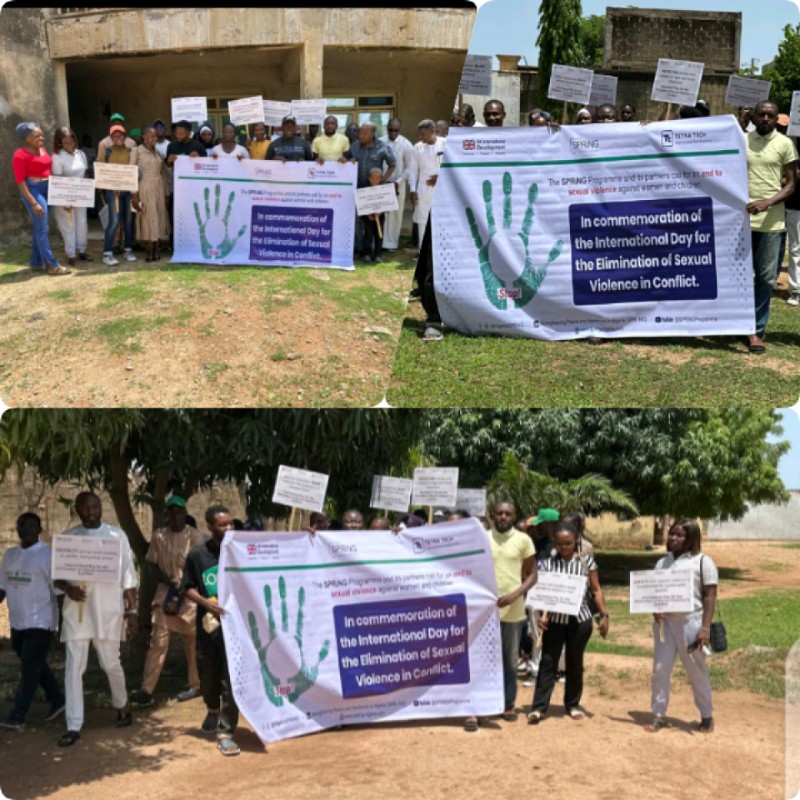
NEWSDAILYNIGERIA:Stakeholders against Sexual violence on Friday in Kaduna marched against all forms of sexual violence, with a call on policymakers, government authorities, communities and citizens to do the needful to protect victims, and prosecute offenders to serve as deterrent to others.
The sentitization program, is in commemoration of the 2026 International Day for the Elimination of Sexual Violence in Conflict under the Strengthening Peace and Resilience in Nigeria (SPRiNG) Programme.
The event attracted civil society organisations, government ministries, development partners, youth groups, women advocates and peacebuilding institutions among others.
Speaking to Journalists at the event, Country Coordinator of CareFronting Nigeria, Dr. Maji Peterx, said the event was organised by partners of the SPRiNG Project to mark the International Day for the Elimination of Sexual Violence in Conflict and draw attention to the devastating impact of sexual violence on individuals and communities.
He further said sexual violence has increasingly become a weapon used during conflicts and periods of insecurity to deepen trauma, instill fear and exploit the vulnerability of victims.
Adding that the project brings together organisations including Care Front Engaging Borders, Interfaith Mediation Centre, Gender Awareness Trust, Yusuf Bala Usman Institute and several government ministries and institutions working towards peacebuilding and social cohesion.
According to him, recent incidents of abduction and sexual abuse across parts of the country demonstrate the urgent need for society to reject every form of violence.
“We stand together as partners and as people who believe in human dignity to say no to the normalization of sexual violence. Women deserve dignity and respect. Men also deserve dignity and respect. People’s vulnerability should never be exploited,” Peters stated.
He also assured of efforts to tackle sexual and gender-based violence in Nigeria, acknowledging that government and civil society organisations have made progress but stressed that much more remains to be done.
Pointing out that the establishment of Sexual Assault Referral Centres in Kaduna State and the increasing involvement of civil society organisations in providing psychosocial support, trauma counselling and assistance to survivors.
He however, lamented that cases of rape, domestic violence, forced marriage, abduction and other forms of abuse continue to occur because many people have become desensitised to them.
“The issue is that we are beginning to normalize these acts. Domestic violence, rape, forced marriage, abductions and other forms of abuse are still taking place. We must continue to speak against them because they are not what we want to see in our society,” he said.
Peterx referenced the Violence Against Persons Prohibition (VAPP) Act, which has been domesticated in Kaduna State, noting that the law already provides punishments for various forms of sexual and gender-based violence.
On the controversial issue of castration for convicted rapists, Peters said while severe punishments may serve as deterrents, policymakers must carefully consider their broader implications.
“We are calling for punishment for anyone who perpetrates acts of sexual violence. The focus should be on ensuring justice for victims and accountability for offenders,” he stated.
Similarly, the Kaduna State Representative of the SPRiNG Programme, Barau Emmanuel, said the commemoration provided an opportunity for stakeholders to unite their voices against sexual violence in conflict situations and within communities.
He described SPRiNG as a United Kingdom-funded four-year initiative aimed at reducing violence, promoting peaceful coexistence and strengthening the resilience of communities affected by conflict and climate-related challenges.
According to him, findings from community engagements have revealed that many victims continue to suffer in silence because of stigma, fear and societal pressure.
“This programme serves as an opportunity for us to voice our concerns and advocate for the prevention of sexual violence in conflict situations as well as within our communities,” he said.
He noted that some members of society inadvertently encourage the persistence of sexual violence by blaming and shaming victims rather than supporting them.
“We have discovered that some people play the role of supporters to violent sexual conduct by trying to shame victims. We must put a stop to that and also end the culture of secrecy and silence that allows perpetrators to continue these harmful practices,” Emmanuel added.
According to him, effective prosecution of offenders would serve as a strong deterrent and help reduce the prevalence of such crimes.
“It is not enough to have laws on paper. People must see that there are consequences for committing these offences. When prosecutions happen consistently, there will be a significant reduction in these crimes,” he said.
One of the participants at the event, Jude Kantiok expressed concern about challenges survivors of sexual violence face accessing justice.
He observed that many offenders continue to move freely within communities despite allegations against them, while victims are left to deal with emotional and psychological trauma.
“The government needs to strengthen policy implementation and ensure that justice is accessible to everyone. Too often, victims are left without support while perpetrators face little or no consequences,” he said.
“There are men who are abused, beaten and subjected to different forms of violence. Sexual violence should not be viewed from only one perspective. Every victim deserves protection and support,” the participant added.
On her part, Faith Marcus, called on victims and members of the public to reject fear and speak out against any abuse.
“Most times people are afraid of stigma, intimidation and what society will say if they speak out. We want victims to know that there are people willing to listen to them and support them without judgment,” she said.
“Some victims carry the pain for years because they are afraid of being rejected. Others become depressed or develop anxiety due to community pressure. That is why support systems are very important,” she added.
The International Day for the Elimination of Sexual Violence in Conflict is observed annually on June 19 following its proclamation by the United Nations General Assembly in 2015.
The day seeks to raise awareness about conflict-related sexual violence, honour survivors and recognise those working to prevent and respond to such crimes worldwide.
The observance is linked to United Nations Security Council Resolution 1820, adopted in 2008, which recognised sexual violence as a tactic of war and a threat to international peace and security
Highpoint of the event was the peace March by stakeholders and participants carrying placards with several inscrptions against all forms of sexual violence and lots more.